Why Authors Should Stop Dismissing AI-Generated Images
Some thoughts on the use of AI images in Creative Writing
Why Authors Should Stop Dismissing AI-Generated Images
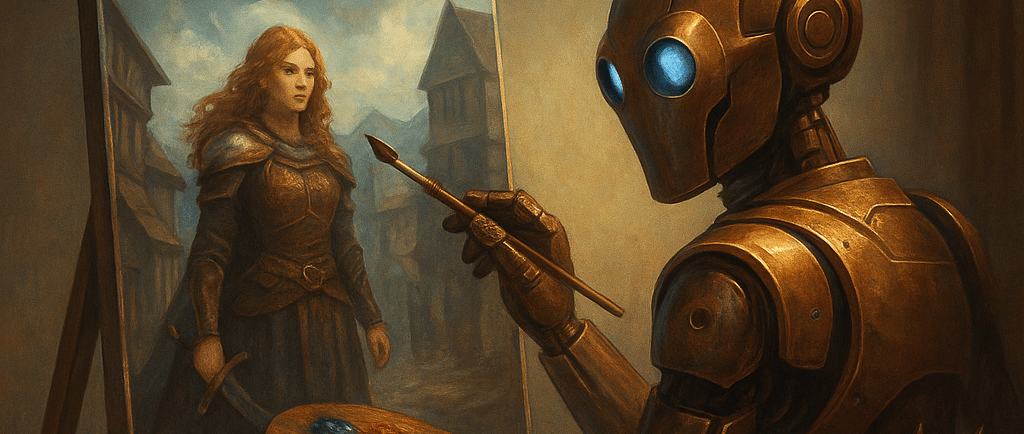
We hear a lot about AI generated art these days, and opinions can be highly polarised. There’s a very vocal faction of anti-AI people in the artistic community, and some authors are instinctively wary of using computer generated images, feeeling that it may be depriving human artists of work, or devaluing the creative process, but it's worth considering the positive role they may play.
In the past, independent authors had two options for website imagery: spend a lot of money paying a professional artist to produce bespoke artwork, or settle for inexpensive generic stock photos that are unlikely to look anything like the worlds they’ve created. If you didn't have the budget to pay commercial rates for original pieces of artwork, you had to either settle for a mediocre generic substitute, or you were out of the game. Neither choice serves the interests of independent authors. AI gives writers a way to visually evoke their fiction without draining their budget or surrendering to soulless, cookie-cutter stock imagery.
Readers don’t just come to an author’s site for a book blurb. Websites have moved on from the early days of the internet, and a text-only site is unlikely to engae anybody’s interest for very long. A visitor confronted with pages of nothing but text, or images with no more than a tenuous connection to the stories is less likely to linger, subscribe, or feel inclined to explore further. Atmospheric AI-generated illustrations; tailored to echo the themes of your own work, can create the same sense of tone and texture that the prose delivers. This isn’t about dictating how readers imagine every detail, but about offering a glimpse into the mood of your world, into what you as an author are seeing.
Critics often argue that AI images compete unfairly with human artists. This is a false objection. Independent authors using them for websites are not replacing artists; they are using them to fill a gap where art would never have been commissioned in the first place. Few writers can afford to hire illustrators for every blog post, background banner, or newsletter header. For these small, supplementary uses, AI provides visual context where otherwise there would be nothing.
Ultimately, AI-generation of images is just another tool. It doesn’t erase the value of human-made art, any more than the invention of photography or computer graphics software did. Nor is a machine dictating how an author should imagine their own worlds. The creative input comes from the human being generating the instructions, not the algorithm. What Ai tools do is expand the toolbox, offering writers new ways to communicate atmosphere and identity without prohibitive costs, levelling the playing fieild substantially for those who don’t have a lot of surplus cash to spend on promotional materials.
Using AI generated art in the way I use it on my website isn’t replacing the work of any human artist, it’s filling a space where, without it, no art would have existed.
The claim that AI art infringes on the intellectual property rights of human artists is also an invalid objection. An AI generated piece of artwork similar enough to constitute infringement of copyright is just as illegal as one created with a paintbrush.
AI models are trained on large datasets of images, but they don’t “copy” them directly; they generate new outputs. This isn’t really any different to art students studying the works of established artists and analysing how they’ve created their artwork in order to produce art of their own.
At present, the U.K. is ahead of most countries in having established a specific legal position on AI- assisted (or AI-generated) art. Under U.K. law, copyright on art produced using AI belongs to the person who created the instructions which were given to the AI to produce that art.
It seems to me that the negative reaction from some towards AI images is part of a broader issue, which largely results from misunderstanding of what so-called “AI” actually is, and how it works. A substantial amount of the blame for this should be directed at the AI developers themselves who chose to refer to Large Language Models as “Artifical Intelligence”, which is highly misleading, but that’s a subject for a whole different post…
© 2025. All rights reserved.
The images on this website are AI generated, which makes it possible to give readers some additional impressions of the flavour of these stories, in a way which wouldn't otherwise exist. For some further thoughts on this, see the blog post: